Run on Microsoft Fabric, 11 November 2026
Move the logic to Microsoft Fabric. Keep the proof.
Microsoft Fabric gives you the lakehouse, the notebook and now an app layer, Fabric Apps, in preview. It does not give you evidence that the logic you rebuild there matches the workbook or the Power App it replaces. Power Migrate produces that evidence, and we have run it on Fabric from end to end.
11 November 2026
What we ran
The workbook is the public FP&A month-end model: 8 sheets and 2,477 formula cells, built with the habits that make real models hard to migrate. It went onto Fabric in three parts.
-
01
Inputs as lakehouse tables
The workbook's 1,275 input cells became six lakehouse tables: orders, the price list, the region map, the assumptions, the adjustment on the hidden sheet and the remaining inputs. Every row keeps the sheet and row it came from, and the tables turn back into the workbook's inputs exactly.
-
02
The generated code in a Fabric notebook
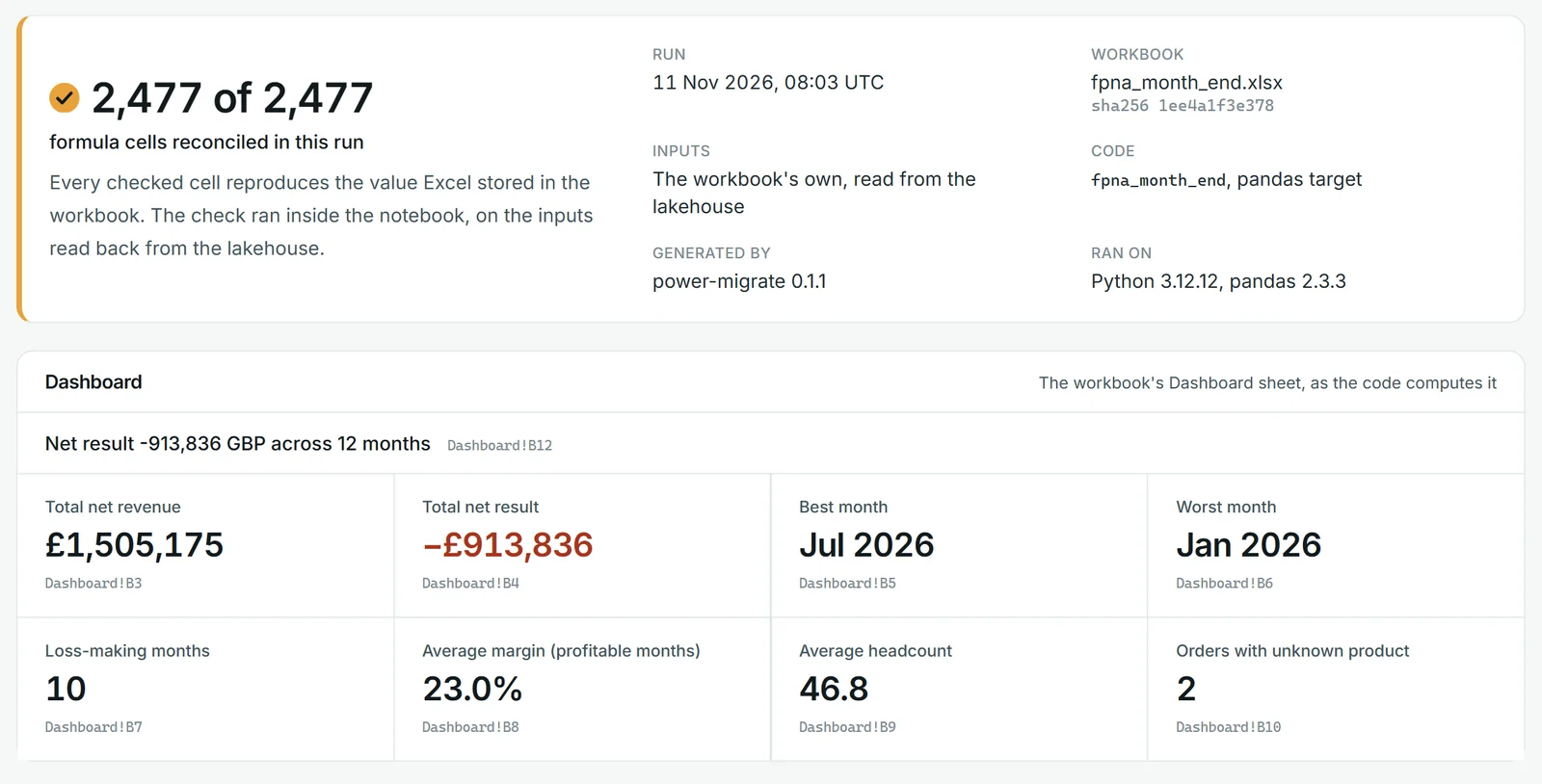
A Fabric notebook runs the pandas package Power Migrate generated, unchanged, on those tables. It then re-checks every formula cell against the value Excel stored in the workbook: 2,477 of 2,477 reconciled, 0 differ. A run takes under half a minute on an F2 capacity, and every run's figures are kept under its run id.
-
03
A Fabric App for review and sign-off
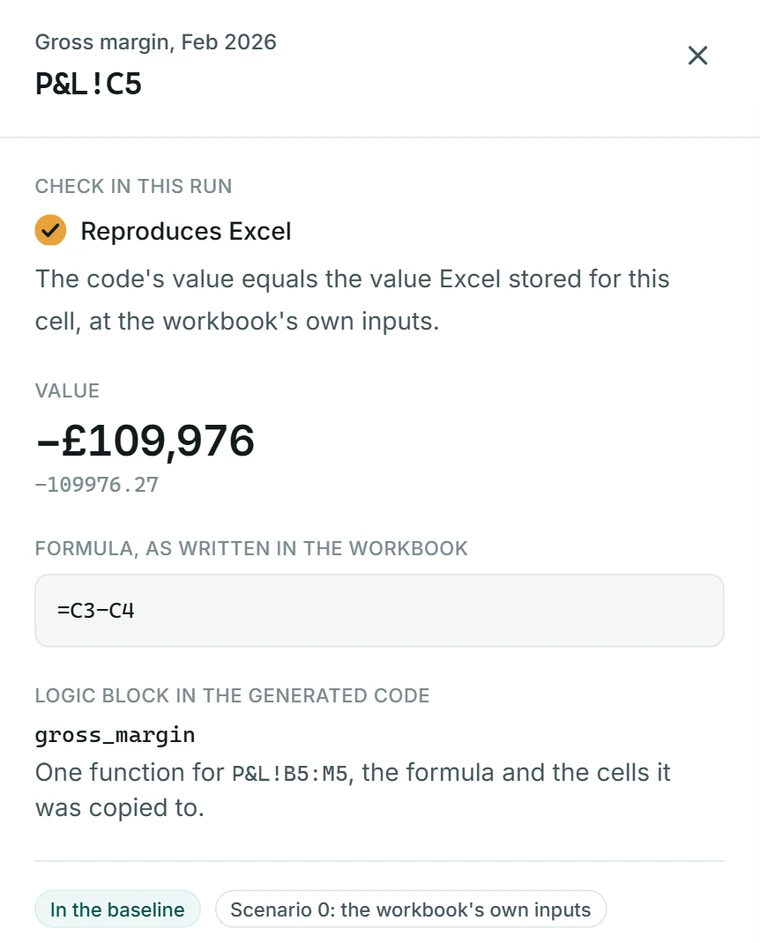
A Fabric App reads the results. Each figure shows its workbook cell; selecting one shows its formula, its logic block and its check. The management adjustment typed on the workbook's hidden sheet is flagged. A reviewer signs a run off, and the sign-off stays attached to that run's figures.
- Formula cells reconciled in Fabric
- 2,477 of 2,477
- Cells that differ
- 0
- Input cells, in lakehouse tables
- 1,275
- Target
- pandas, in a Fabric notebook
The review app, as it ran
Two screenshots of the app in our Fabric workspace. The figures are the sample's, so they are synthetic; the checks are real.
What this shows, and what it does not
We say tested equivalence, never guaranteed identical. A run certifies the checks it made, so here is exactly how far this one goes.
What it shows
- The generated package runs in a Fabric notebook as it was generated, on the pandas that Fabric provides.
- The check travels with the code. The comparison behind the published report ran inside Fabric, on inputs read back from lakehouse tables, and gave the same result.
- The results sit in lakehouse tables that a Fabric App reads, with each figure's cell, formula and check beside it.
- A sign-off can be tied to the figures of one run, because every run's outputs are kept.
What it does not
- One workbook: our public sample, with synthetic figures. Not a client model.
- One target: pandas, in a Fabric Python notebook. Not Spark, and the SQL target was not part of this run.
- Checked at the workbook's own inputs. The generated input variations on the sample page were checked against Excel on Windows, not in Fabric.
- The scenarios the notebook computes on other inputs are labelled in the app as computed by the same code, not checked against Excel.
- The app was written for this demonstration with Microsoft's Fabric Apps SDK. Power Migrate generated the Python behind it; it does not generate Fabric Apps or TypeScript.
- Fabric Apps is a preview, and previews change.
- The sign-off shows the workflow. It is not offered as an audit control as it stands.
How a move to Fabric goes with this
-
01
Map
Every formula, screen, data source, flow and hidden sheet is inventoried before anything is rebuilt.
-
02
Extract
The logic becomes readable Python, pandas or SQL by deterministic rules. Correctness never depends on AI.
-
03
Prove
Every value is checked against the original engine: Excel itself for a workbook, Microsoft's open-source Power Fx interpreter for a canvas app. Every difference and every cell left unconverted is named, with its reason.
-
04
Build
The tested code runs in a Fabric notebook and the Fabric App goes on top, by hand or by agent. The reconciled baseline is the test the Fabric build has to pass.
The same proof exists for Power Apps canvas apps. On Microsoft's own chess sample app (11 screens, 4,586 formulas), 4,719 of 4,844 properties reconciled against Microsoft's open-source Power Fx interpreter over 90,330 checks, with 0 differences; the other 125 are named in the report as unchecked or not translated. See the published conversion, or read how a conversion works.
Moving something to Fabric?
Architects
Run it on one of yours
The command-line tool runs inside your own environment, so nothing leaves it, and is free for 30 days. Run it on a workbook or a canvas app that is heading for Fabric, beside the way you check a migration today, and tell us what it gets wrong.
Start a free 30-day trialPractice leads
Running migrations for clients
A team licence is £999 + VAT per team per month and covers the whole team. For several teams, or a firm that runs Fabric migration work for clients and wants to carry the reports under its own name, we agree a price for the whole arrangement.
Talk to usMicrosoft, Microsoft Fabric, Power Apps, Power BI and Excel are trademarks of the Microsoft group of companies. Power Migrate is independent and is not affiliated with or endorsed by Microsoft.